Spiti Valley Bike Trip Guide 2026: Best Places to Visit, Route & Season

If there’s one ride every Indian biker puts on their list, it’s a Spiti Valley bike trip. Cold desert mountains, roads that hug cliff edges, monasteries older than most countries, and villages so high up they touch the clouds — Spiti isn’t just a destination, it’s the trip people build their whole riding year around. This guide covers everything you need: the best time to visit Spiti Valley, the route, the must-see stops, and a few things nobody tells you before you go.
Why Riders Keep Coming Back to Spiti
Spiti means “the middle land” — the stretch of Himachal Pradesh sitting between India and Tibet. Unlike Ladakh, which sees heavier tourist traffic, Spiti still feels raw: narrow single-lane roads, tiny homestays, and villages where satellite dishes sit next to 500-year-old monasteries. For bikers, that combination of technical riding and untouched landscape is exactly the draw.
Best Time to Visit Spiti Valley
Timing your Spiti Valley bike trip right makes the difference between a smooth ride and a trip stuck at a landslide.
- June to mid-October is the full window when both the Manali and Shimla routes are open.
- June–July: Kunzum Pass has just opened, roads are freshly cleared, and the valley is green. Expect some river-crossing sections near Chandratal still running high.
- August–September: The most popular stretch — stable weather, dry roads, and (in September) golden poplar trees turning the valley gold.
- Late September–October: Fewer crowds, colder nights, but some of the clearest mountain views of the year.
- Winter (Nov–April): Spiti is cut off from Manali; only reachable via the longer Shimla–Kinnaur route, and only for very experienced riders prepared for sub-zero conditions.
If this is your first Spiti ride, aim for late June through September.
Spiti Valley Route: Manali vs. Shimla
There are two ways in, and most riders do a loop — one route in, the other out.
- Manali → Kaza (via Kunzum Pass): Shorter and more scenic, but season-dependent — only open once the pass clears of snow, usually by mid/late June.
- Shimla → Kinnaur → Kaza: Longer but accessible for more of the year, and takes you past Nako and the Kinnaur valley, which most Manali-only riders miss.
A full loop (Delhi–Shimla–Kinnaur–Kaza–Kunzum–Manali–Delhi) typically runs 7–10 days, depending on how many stops you build in.
Best Places to Visit in Spiti Valley
These are the stops that make a Spiti bike trip what it is:
Kaza — The valley’s main town and your logistics base: fuel, food, permits, and a good night’s sleep before pushing further up.
Key Monastery — Spiti’s largest monastery, perched at over 4,100m, visible from miles down the valley.
Chandratal Lake — “Moon Lake,” reached via Losar and the Kunzum Pass. One of the most photographed spots in the Himalayas, for good reason.
Langza — Known as the Fossil Village, with a giant Buddha statue looking out over the valley. Marine fossils are still found in the surrounding hills — a reminder this cold desert was once an ocean floor.
Hikkim — Home to the world’s highest post office. Sending a postcard from here, addressed to yourself, is a Spiti tradition for a reason.
Komic — The highest motorable village in the world, sitting quietly above Hikkim.
Chicham Bridge — Asia’s highest bridge, connecting Kaza-side villages across a dramatic gorge.
Tabo Monastery — Often called the “Ajanta of the Himalayas” for its centuries-old wall paintings.
Nako — A quiet lake village along the Kinnaur route, worth a night’s stop on the way in or out.
Spiti Bike Trip Tips
A few things worth knowing before you throw a leg over the bike:
- Altitude sickness is real. Kaza sits above 3,600m, and several stops go higher. Hydrate, take it slow on the first day, and don’t skip acclimatization.
- Permits: Indian citizens don’t need an Inner Line Permit for Kaza and most of Spiti. Foreign nationals do — sort this in Kaza or in advance.
- Fuel up whenever you can. Petrol pumps are sparse once you’re past Kaza — Recon, Kaza, and Tabo are your reliable options.
- Bike choice: A Royal Enfield Himalayan or similar rugged, high-clearance bike handles the terrain best, though smaller bikes complete the route every season too.
- Network: BSNL has the best (still patchy) coverage. Don’t count on connectivity once you’re deep in the valley.
Bring Back More Than Just Photos
A Spiti trip changes how you see a map — every pass, every village name suddenly means something. The problem is, six months later, the photos live buried on your phone and the memory starts to blur into the next trip.
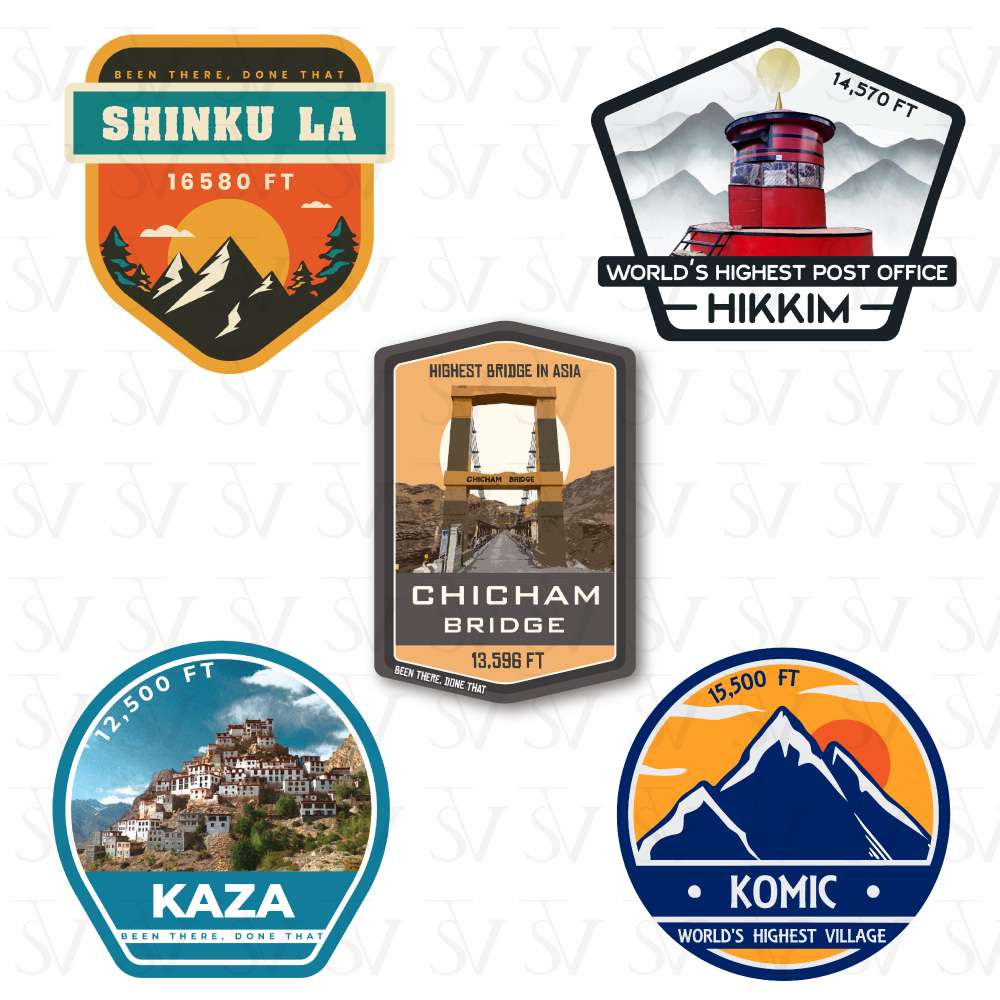
That’s the whole idea behind our India Series stickers — real place names, real altitudes, stuck where you’ll actually see them: your helmet, your panniers, your laptop. If you’ve done (or are planning) this route, a few worth checking out:
- Hikkim, Kaza, Komic, Chicham Bridge & Shinku La (Pack of 5)
- Chicham Bridge & Kaza (Pack of 2)
- Langza & Bara Lacha La (Pack of 2)
Peel, stick, done — proof of the ride that doesn’t fade like the memory does.
Frequently Asked Questions
How many days do you need for a Spiti Valley bike trip?
Most riders plan 7–10 days for the full Delhi–Shimla–Kinnaur–Kaza–Kunzum–Manali–Delhi loop. A shorter Manali-only there-and-back can be done in 5–6 days if the pass is open.
Is a Spiti Valley bike trip safe for beginners?
It’s manageable for a reasonably confident rider, but it isn’t a beginner route — narrow roads, high altitude, and unpredictable weather mean some riding experience helps. Going with a group for your first attempt is a common (and sensible) choice.
What is the best bike for a Spiti Valley trip?
Rugged, higher-clearance bikes like the Royal Enfield Himalayan are the most popular choice for the terrain, though the route is completed on smaller commuter and touring bikes every season too.
Do I need a permit to visit Spiti Valley?
Indian citizens don’t need an Inner Line Permit for Kaza and most of Spiti. Foreign nationals do, and can arrange it in Kaza or in advance.
Final Word
A Spiti Valley bike trip rewards patience more than speed — the best moments are usually the unplanned stop at a monastery, a chai at a roadside dhaba in Nako, or the silence at Chandratal at sunset. Time it right (June–September), fuel up when you can, and go slow enough to actually take it in.